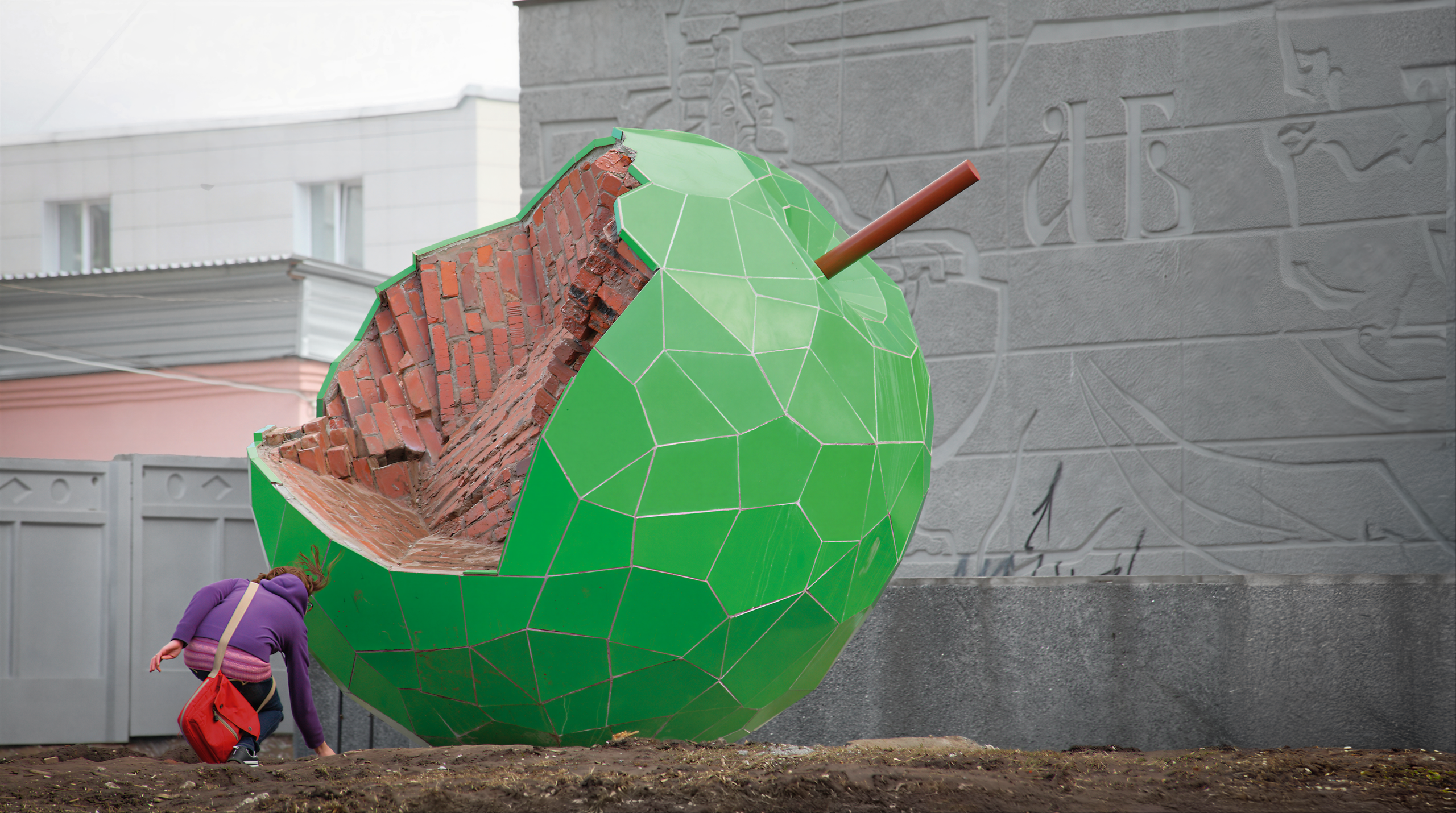
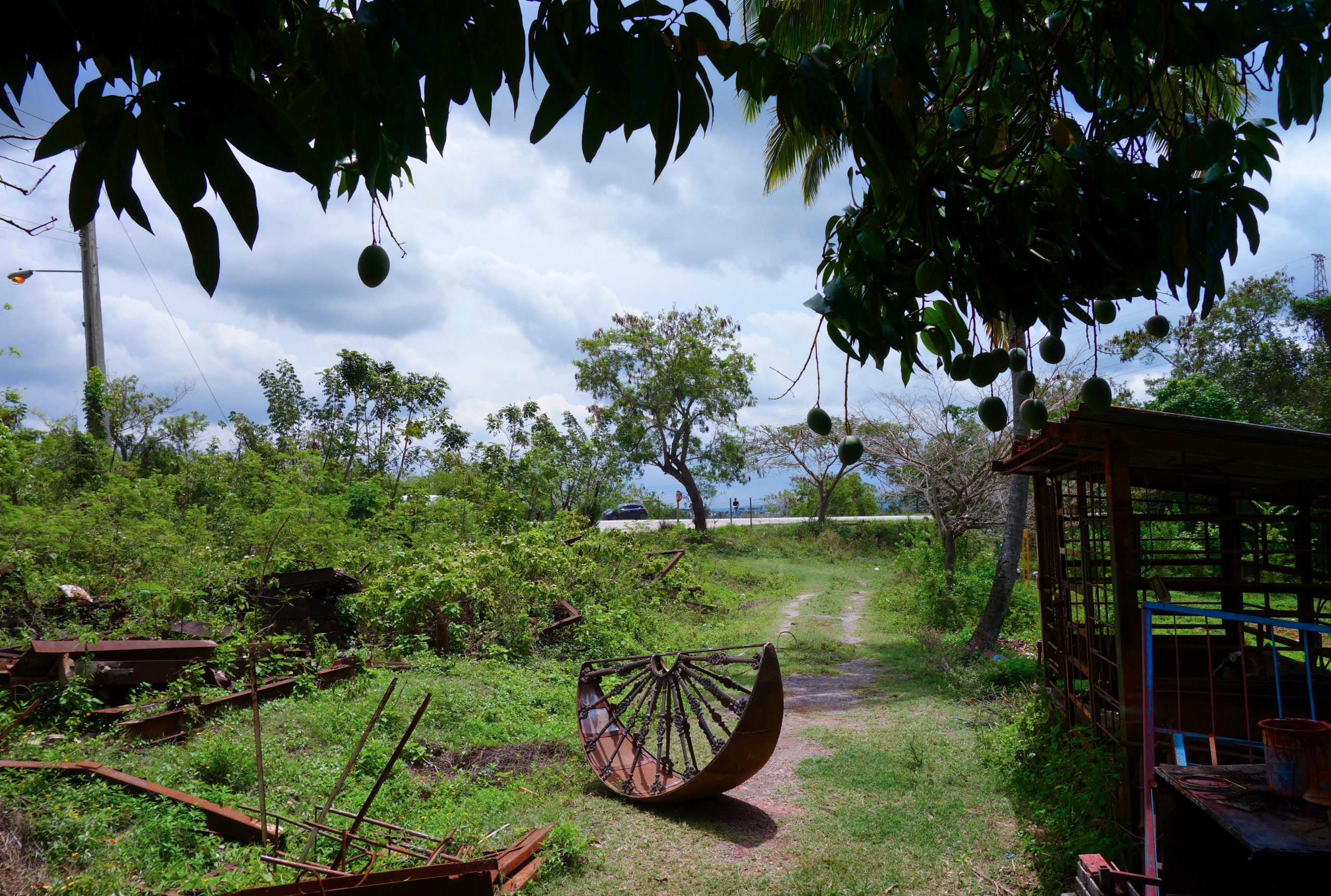
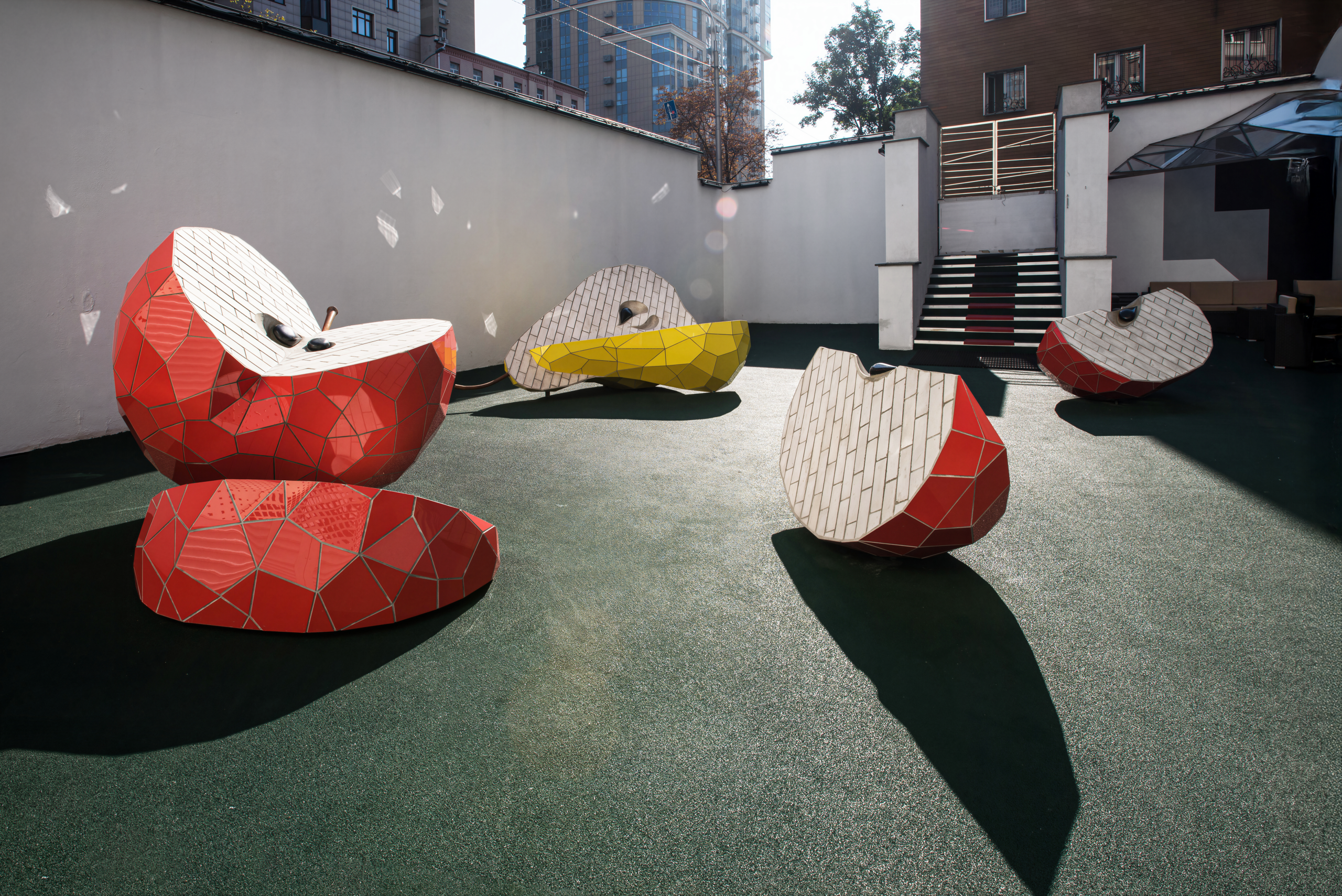
Zhanna Kadyrova. “Ogryzok” from the series “Fruit.” 2009–2010. Fragment of a brick wall, ceramic tile, cement, metal pipe
Project description
The artist created the first objects of the project simultaneously with the series “Calculation,” so they are thematically connected. Fruits sliced into pieces referred to the insatiable distribution of resources by those who remain in power, and also engaged in a polemic on the topic of gentrification: the illegal seizure of the city by developers who neglect the preservation of cultural heritage and historical architecture.
One of the works is an apple core that Kadyrova created during her residency in Sharhorod, where projects were simultaneously taking place on the territory of the former sugar factory from 1882. The artist recalls that in the 1990s a local entrepreneur bought this site, planning a grand transformation of the space into a hybrid cultural hub with restaurant and hotel complexes [1]. His plans did not come to fruition, and he later moved abroad. At that time, the artist laid out an apple core from the remains of the factory’s brick walls as a symbol of waste and depleted resources that the city and its inhabitants inherited.
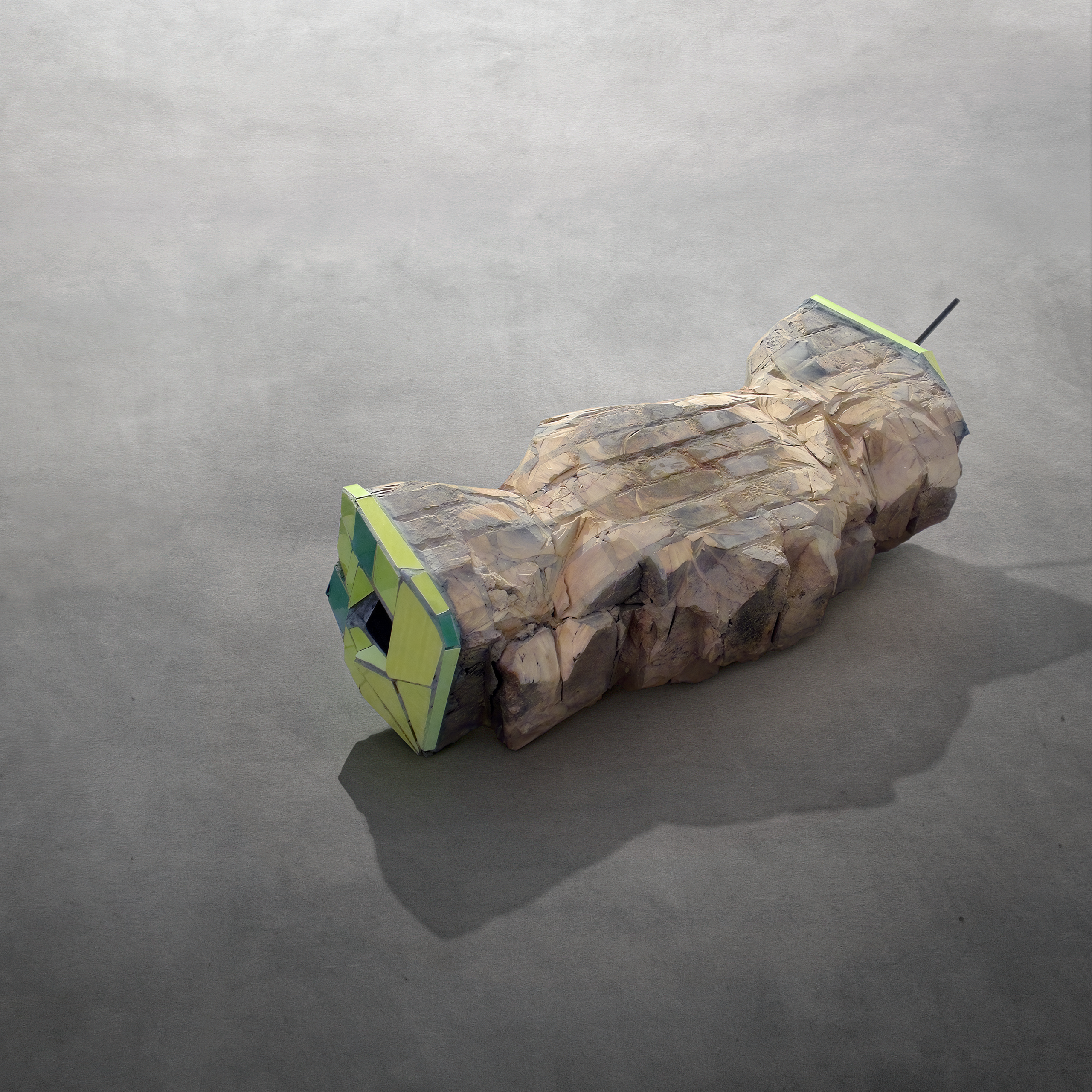
Over the following years and to this day, the artist creates sculptures of sliced or bitten fruits from various materials in many locations. At one time, she presented fruits made of ceramics, bricks, and metal, creating site-specific installations. For these, Kadyrova chose local resources that were sources of extraction or enrichment during different periods—from Soviet industrialization to capitalist hyperproduction. Later, the author realized similar projects in other countries, including Cuba and China, reflecting local specifics of labor interaction and economic context through the material.
The “Fruit” project, which consists of four separately lying elements, speaks about the endless redistribution of economic resources occurring in modern society. The largest fragment of the composition is half a fruit; a smaller part is a quarter of the fruit, and the smallest are empty, eaten slices. Modeled after a citrus fruit, Kadyrova’s “Fruit” appears before the viewer in an unexpected black-and-white palette. According to the artist, such monochrome binarity was chosen as a symbol of businessmen’s dress code. Thus, Kadyrova specifies the conversation about economic problems, focusing on their humanitarian component. The symbolic flesh of the half is covered with mirrored tiles, in which the viewer can see their reflection, recognizing themselves as part of the exploited human resources. At the same time, the half fruit still allows one to see their reflection despite the fragmentation of the sculpture’s facets. Even less human presence is reflected in the quarter of the fruit, and the eaten slice contains no mirrored “flesh”—it is covered with matte white tiles. Chewed up in the continuous race for economic growth, the person completely disappears from view, becoming only an easily accessible and easily replaceable resource [1].
- Kadyrova Z. Fruits, 2008. Zhanna Kadyrova. Berlin : Distanz, 2026, 229.
- Chervynk O., “Calculation.”, in Zhanna Kadyrova, (Kyiv : Publishing Program of the Vladimir Smirnov and Konstantin Sorokin Foundation, 2013), p. 64.
Works From This Series