Oleksiy Sai was born in 1975 in Kyiv. He graduated from the graphic design department of the Kyiv Art and Industrial Technical School (1994), where he obtained the specialty of an artist-designer. There he learned to design banners using pre-digital technologies relevant in the 1980s (phototypesetting, etc.). Later, he graduated from the easel graphics department of the National Academy of Fine Arts and Architecture (course of Mykola Kompanets, 2001). While studying at the academy, Sai worked as a graphic designer in an advertising agency, mastering computer programs. After completing his studies, the artist combined creative practice in the studio with commercial activities in Kyiv advertising agencies. Since 2004, Oleksiy has been a co-founder and board member of the first creative agency in Ukraine, Sahar. Until 2022, he worked as a director of advertising videos while simultaneously developing his own artistic practice. This professional duality influenced the main themes and methods of Sai’s creativity, as well as his understanding of the specifics of artistic creation. If work in advertising is a profession for him, i.e., fulfilling an order, then artistic creativity is much less dependent on the external demands of a gallerist, art dealer, viewer, or collector.
“Excel-Art”: a series of series about office everyday life
Working in advertising agencies, Oleksiy Sai gained extensive experience of office life, corporate culture, and the daily routine of “white-collar” workers. Accounting reports and random Excel documents became the material and method of the artist’s main creative line. Sai uses all the possibilities of this program — from color filling of cells, rows, and columns to inserting complex formulas, comic bubbles, and charts. At first glance, these works may seem unserious, but each of them within this mega-series is the result of long, monotonous, and meticulous work.
These works — tables materialized using digital printing on metal — are not paintings and do not strive for the “magic of the artistic gesture” or the aura of artistic labor and its result. On the contrary, they appeal to the recognizable experience of people who deal daily with tables, cells, and numbers. Scenes of office life are presented with comic sharpness but without condescension: Sai knows this environment well from the inside. His irony combines with a sense of boredom, alienation, and doom inherent in office existence, but at the same time is not devoid of subtle lyricism and melancholy.
Through his works, the artist communicates with office workers — those who inspire and become prototypes of the characters in his works. The artist emphasizes that Excel art is an alternative to painting [1]. Printing on metal creates an effect radically different from traditional oil on canvas. The many hours the artist spends at the computer and digging into spreadsheets do not undermine but imitate the practice of an office worker: “I prefer to struggle with the “bad” material (the Excel program. — Ed. E. B.) and preserve the idea, maintain tension, and work while being under tension. I want to show people who work in this program that it is a whole world” [2]. This world is very familiar, close to the body of everyday life, and is not intended, according to the artist’s idea, to evoke admiration but recognition and tragicomic irony that help to move forward within routine tasks: “They are attractive, bright, but I want to believe that a person feels unpleasant when looking at them. <…> they can use the picture as a catalyst for critical reflection” [3].
Sai made his first attempts at Excel creativity in 2004. In 2007, the first exhibition with “Excel-Art” works opened at the CEH Gallery. Since then, the artist has been developing this project, making small pauses. Over about twenty years, “Excel-Art” has unfolded into a series of sub-series: urban landscapes, construction scenes, nature motifs, kitschy animals, allusions to Arcimboldo, smileys, and others. Over time, favorite characters emerge within the series, gaining their own stories and development. For example, a woman who copies something on a copier “ages” over the years: Sai creates new works with her, but in each subsequent one, her heels get lower and her posture more stooped. Another such character is a man who has just been fired: holding a box with his belongings, he tries to catch at least someone’s sympathetic glance, but former colleagues have already forgotten him and are intently staring at monitors.
The corporate person as an object of attachment and research
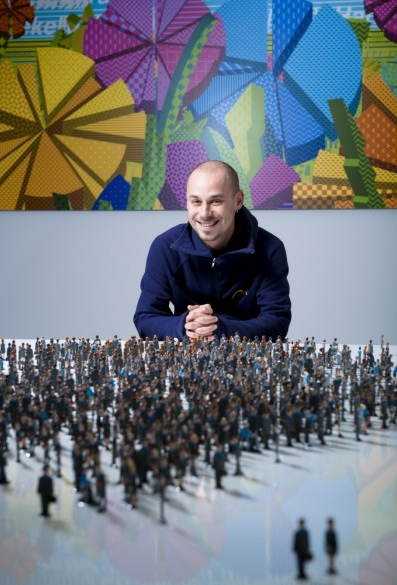
Later, Oleksiy Sai interprets corporate culture in an anthropological sense. The office appears in the artist’s works as an object of study. Thus, a series with a crowd of little soldier-figures arises, resembling bacteria in a Petri dish under a scientist’s microscope. Bacterial culture is a collection of viable microorganisms artificially grown in laboratory conditions on a nutrient medium for disease diagnosis. Similarly, Sai seems to “breed” the culture of homo corporaticus for analysis and diagnosis of diseases, only societal ones.
For this, he singled out six archetypal images based on his own work in Excel series: the aforementioned woman by the printer, the fired man with a box, a man and a woman standing straight, a friendly man (offering a handshake), and a man at a computer. A thousand toy soldiers were cast to order, hand-painted by the artist and his wife, artist Svitlana Ratoshnyuk, and later exhibited in various installations called “Mold” (the first presented among the projects of twenty finalists of the PinchukArtCentre prize in 2009). This name shows Sai’s ambivalent attitude towards his characters: in everyday perception, it is something disgusting, but at the same time — a pervasive and hyper-adaptive form of life that arouses genuine interest.
The next stage of development of the corporate person appears in the “Welcome Attitude” project (CEH Gallery, 2010). Sai sharply changes the perspective and makes macro shots of his little men in their everyday life. During the Revolution of Dignity, the artist observed extraordinary unity of civil society: on Independence Square among protesters, representatives of all strata and professions, including “white-collar” workers, could be found. Considering this, the author transforms his office “soldiers”: he transports them on the ground, twists them, burns them. As a result, the “beaten by life” heroes appear in portrait photographs in the “We Have Become Better” series (2014).
“Bombed Out”: phoenix works reflecting on the war
Another direction, or rather an antithesis to “Excel-Art,” is the “Bombed Out” series, started in 2016. Reacting to the Russian-Ukrainian war (since 2014), Oleksiy Sai destroys some Excel works: he cuts off the printed surface and, using an angle grinder and drill, carves new scenes on old surfaces. These are landscapes resembling satellite images of Eastern Ukraine lands covered with craters after massive shelling. The artist emphasizes: these are not reproductions of images of specific geographical areas. Moreover, he realizes that the enemy uses such photographs, and recognizing familiar places, some viewers cannot hold back emotions. Instead, Sai creates abstract landscapes of war. He does not aim to evoke painful memories but wants to show the world what once habitable land turns into as a result of Russian aggression.
Profile works: from Maidan smoke to mystical parasites
Another series, born under the impression of the Revolution of Dignity, is the “Monuments of Smoke” sculptures, made from metal C-profile. The artist transforms construction material into Baroque compositions, prototypes of which are the “choreography” of smoke from a stun grenade. Sai saw its effect firsthand under the feet of protesters: during the explosion, shock occurs, and smoke streams spiral out as if in a rapid [4]. Since 2015, the author has been creating peculiar objects dedicated not to grenades as weapons for suppressing social uprising but to those who carried out this uprising, risking their lives and health.
After 2014, Oleksiy Sai continues to use C-profile in creating sculptural installations. Such is “A Pillar That Can Not Stand” (2015) — a Corinthian order column destroyed by barbarians, symbolizing the fragility of the most powerful empires and civilizations. Or site-specific installations like “Parasites” — tangled creatures made of metal profile on the walls of old wooden buildings, created within Ukrainian art residencies “Biryuchiy 2013” and in the village of Zhovid, Chernihiv region (2017).
Installations: office readymade, spectacle of wartime, ironic site-specific
Since 2010, alongside developing the “Excel-Art” series, Oleksiy Sai has been creating large-scale installations for personal and group exhibition projects, using various office supplies. One of the first signs of this series is the “Relations Tower” sculpture (at the “Those Who Came in the 2000s” exhibition, curators Oleksiy Tyta-renko, Ruslan Tarabukin, 2010), made from business cards that Sai collected from colleagues and acquaintances. The work resembled a half-ruined tower constantly vibrating due to a built-in mechanism. Thus, the artist marked the instability and fragility of financial and economic systems built on vain agreements and deals. At the same time, if you look closely at the business cards that made up the “unreliable” structure, it is hard not to be amazed by the variety of designs on the small cardboard sheets and not recall the famous business card scene from the movie “American Psycho” (2000).
Later, Sai creates office installations whose main element is a square raster overhead lamp typical for ceilings in offices and non-residential premises in Ukraine and worldwide since the 2000s. Installations “Solarium” (2010), “Time to Say Goodbye” (“Space Odyssey,” curator Oleksandr Solovyov, 2011), “Abandoned Camp” (2012), “Nomadic Structure” (2012), “Object that Enlightens Itself” (2014), “Mold” (solo exhibition “Endangered Species,” YermilovCenter, 2014), “Empire of Plenty” (2016), “Jewel” (2017), “Sorry” (2017) — each in its own way, but in Sai’s recognizable tragicomic style — point to the “luxuries and miseries” of representatives of modern office-corporate culture. And again, culture in the anthropological sense: “For me, it is like culture in an archaeological section. Like the Trypillians… Culture as a set of lifestyle, aesthetics… the entire social order… I want to remove that whole layer” [5].
The work “Sorry,” which Oleksiy Sai created for the group exhibition “We Hope for Your Understanding” at the Closer art center (2017), appeals to the American expression “sorry,” which combines polite need with hidden indifference. Like the word welcome in the “Welcome Attitude” project, it refers to the hypocrisy of global corporate culture. The installation in the form of a smiley and inscription, constructed from the same raster lamps, is designed not only for a black box but also for open spaces.
This installation became Oleksiy Sai’s first work at the international Burning Man festival in the Black Rock Desert (Nevada, USA) in 2018. At an event where people from all over the world gather to forget about workdays for eight days and immerse themselves in a post-apocalyptic festive atmosphere in the desert, his SORRY was received with considerable understanding. Already in 2023, during the full-scale phase of the Russian-Ukrainian war, Sai, in collaboration with artist and architect Dana Kosmina, created the performative sculpture “Phoenix”: a metal bird-trident majestically stood on the ruins. In 2024, the artist presented the installation “I’m fine” at the festival — words made from road barriers, residential gates, and signs with the names of Ukrainian settlements brought by soldiers and volunteers from the combat zone. Viewers could approach and touch holes in the metal plates pierced by bullets of Russian occupiers. Sai’s work at Burning Man 2025 — a large-scale audio-light installation “Black Cloud” — was destroyed on the first day of the festival by a powerful sandstorm. The artist and the team could not save either the work or their own tent. However, undeterred, they restored the installation in the form of the inscription NO FATE, referring to the phrase “There is no fate but the one we make ourselves,” part of which is engraved by the heroine of the film “Terminator 2: Judgment Day,” Sarah Connor.
A separate category should be singled out for site-specific installations outside stable series, created on curatorial request or during residencies. For example, “Slogan” (Biryuchiy Symposium 2014) — the application of the craft of drawing banners learned at the technical school with a flair of post-Soviet mental inertia. “Don’t Step on the Rake” (2014) — a large-scale work for the “New Ukrainian Dream” exhibition (curator Oleksandr Solovyov). “Burned” (2015) — an installation about post-Maidan “sobering up,” made on request of the YermilovCenter. “Black Hole” (2017) — an analog realization of one of the Excel paintings for the Brave electronic music festival in Kyiv. “Shovel” (2017) — an object used for documenting a performance within the Ukrainian-Lithuanian residency in Zhovid (curator Ivan Sautkin), remained in this village as a monument to hard but still congenial work.
Graphic series: criticism of bureaucracy and brutal lyricism of war
A graphic artist by education, Oleksiy Sai practically has no projects and exhibited series where he would refer to academic techniques of easel graphics. The “Statements” drawing series became part of the happening project of the Master Art creative association [6] (32 Vozdvizhenka Arts House, 2016). The prolonged layering of bureaucratic texts on top of each other renders their content unreadable, and the practice itself — to Kafkaesque absurdity. Since 2022, under the influence of Russia’s full-scale invasion of Ukraine, Sai has been working on the “News” series: he applies epoxy paint to paper with a brush attached to a screwdriver. In this way, the artist cannot fully control what the explosion drawing will look like. This hints at a state of powerlessness before events but at the same time — the ability to stoically accept fate. Another series, “Lands,” is created on a similar principle but with a ballpoint pen.
“Propaganda”: art in times of war
Oleksiy Sai admits that in wartime, the boundaries between art and informational weapons blur, so he consciously takes on the roles of both artist and propagandist. Among the works created on request of PinchukArtCentre for the “Russian War Crimes” exhibition, which was shown at powerful international venues to testify to the world about Russia’s crimes against Ukraine, the author created the video “6400 frames.” It is a montage of video fragments and photographs documenting Russian war crimes against civilians. The work is built on the principle of subliminal advertising. Sai applies his directing experience, using editing tools to suggest and impress the viewer.
In the sculpture “Will” (2025), created for the World Economic Forum in Switzerland, the artist makes a direct allusion to Robert Indiana’s “LOVE” work. By laying out the word “WILL” in the same font, the author answers the question of what is an unconditional value for Ukrainians here and now. The project was also realized on request of PinchukArtCentre. In 2026, at the 56th World Economic Forum in Davos, Sai presented an installation with a red neon inscription “Change or Die.”
After 2014, the artist actively creates posters that he provides for free distribution on social networks and for printing for rallies supporting Ukraine in various cities worldwide. These posters do not appear on anyone’s order but only as a response to the request of protesters to help with bright and accurate visual appeals.
Oleksiy Sai is an artist who skillfully uses the skills of a creative professional in his artistic practice. For twenty years, he has reflected on his alter ego, inseparably connected with commercial orders, conjuncture, and corporate survival rules. Remaining faithful to Excel art, he consistently experiments in the genres of installation and sculpture. During the full-scale war, Sai takes on the role of one of Ukraine’s most visible artists in the global context, transmitting key messages about unconditional values and universal emotions that resonate with everyone — whether an office worker or a raver in the desert.
- From a research interview on 04.12.2025.
- Oleksiy Sai on changing social connections, new projects, and today’s psychoses | Your Art
- Same source.
- From a research interview on 04.12.2025.
- Aleksey Sai: “Office presentations become more understandable if viewed as prison folk art” — Articles — ARTUKRAINE
- Top managers: Mykyta Kravtsov, Zhanna Kadyrova, Oleksiy Sai, Stas Volyazlovskyi, Viktor Pokydanets, and Maksym Mamsikov; administrator: Semen Khramtsov.