
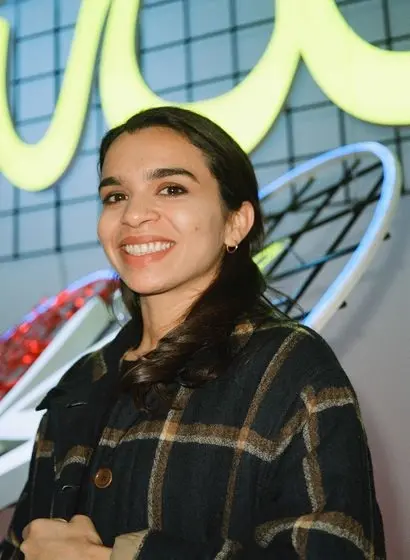
Alia Farid

Alia Farid (b. 1985) lives and works in Kuwait and Puerto Rico, countries she is both from and whose complex colonial histories she reveals through drawings, objects, spatial installations and film. She has a Bachelor of Fine Arts from la Escuela de Arts Plasticas de Puerto Rico (San Juan), a Master of Science in Visual Studies from the Visual Arts Program at MIT (Cambridge, MA), and a Master of Arts in Museum Studies and Critical Theory from the MACBA’s Programa d’Estudis Independents (Barcelona). Farid has completed residencies at Beta Local (San Juan), Casa Árabe in conjunction with Delfina Foundation (Córdoba, Spain), Mathaf: Arab Museum of Modern Art (Doha), Davidoff Art Initiative (La Romana), The Serpentine Galleries (London), La Cité Internationale des Arts (Paris), and marra,tein (Beirut). Recent and upcoming shows include participation in the 32nd Bienal de São Paulo, the 20th Contemporary Art Festival Sesc_Videobrasil, the 12th Gwangju Biennale, and Sharjah Biennial 14. Recent and upcoming shows of her work have been presented at NC-arte (Bogotá), Galerie Imane Farès (Paris) and Sultan Gallery (Kuwait). She is a recipient of the 2018 Art Jameel Commission (Dubai), the Arab Fund for Culture and Arts’ Visual Arts Production Grant, and is shortlisted for the 2019 Future Generation Art Prize.

Monira Al Qadiri’s recent projects investigate the implication of the oil industry for the countries of the Arabian Gulf region, and the precarity of their imminent future. The artist enquires what is left to commemorate when this transient petroleum interval is over. There are several of her works combined for the installation within the Future Generation Art Prize such as large scale sculpture Empire Dye, miniature objects Wonder 1, 2, 3 and the latest video Diver. In the Wonder series, and video Diver, Al Qadiri refers to the historical and cultural legacy of pearl diving and trade practices which were swept away with the emergence of the oil economy. The artist creates the shapes of oil drill bits carved from natural pearls in order to concoct an aesthetic relationship between oil and pearls, where originally none exists. In the video Diver this context is autobiographical. Al Qadiri’s grandfather was a singer on a pearling ship. The music used for with synchronised swimmers’ performance is one of the traditional pearl diving songs. Empire Dye is shaped like a giant seashell and covered in purple. The purple dye has shifting connotations. It is the colour of bad luck in the oil industry, and at the same time an ancient precious pigment extracted from thousands of Murex seashells, symbolic of the power of emperors and kings. The form of the shell, with its tentacles expanding in every direction, signifies both the political and economic ambitions of the fossil fuel industry.

Videoprofile