
Ashfika Rahman
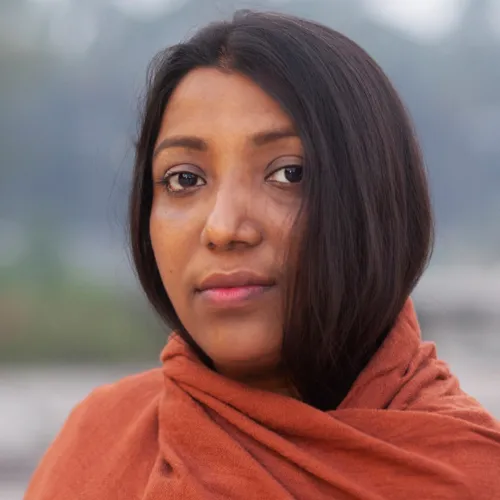
Through photography, prints, text, sculpture, and often working with communities, Ashfika Rahman looks at the role of women in society. Her project Behula and a Thousand Tales emerged as a collaborative effort, shedding light on the plight of women amidst the flood-prone areas and riverbanks of Bangladesh.
Rahman traveled along the riverbanks and gathered the life stories of the women she encountered. It is important to note that the stories also emphasize the experiences of Indian women. And the riverlines shared by both countries include stories that transcend borders and address religious migration. During her journey, Rahman collected stories from both Bangladesh and India, focusing on the border areas where narratives of suppression overlap in many ways. Stories were captured in the form of heartfelt letters, written and later embroidered on green fabric, by women in various native languages, including different indigenous dialects.
Almost all the letters start with “Dear Behula…”, in reference to Behula – a central figure in one of Bengal’s most renowned mythological love tales, Behula and Lakhindar, famous in both the Bangladeshi and Indian parts of Bengal, and penned between the 13th and 18th centuries. In this narrative, Behula’s husband, Lakhindar, succumbs to the curse of Manasa, the Hindu goddess of snakes, on their wedding night. Tradition dictates that those bitten by a snake might be revived if their body floats downriver rather than undergoing cremation. Behula, determined to bring her husband back to life, embarks on a perilous journey with his body, beseeching the gods, including Manasa, for intervention. Her devotion and sacrifices in isolation are revered as the epitome of spousal loyalty in Bengali culture.
The stories shed light on the often overlooked and suppressed narratives of violence against women, but they also encompass the broader context of climate-related challenges. Rivers, often revered as lifelines, serve as the backdrop to this narrative. It is the story of the women living along these riverbanks, and how these rivers carry with them tales of struggle and resilience.
Open-ended, the project also serves as an alternative archive, making the suppressed stories of women accessible to a global audience and resonating worldwide. Hung on fragile threads in space, it is an archive that one would simultaneously like to open, and close.
Through photography, prints, text, sculpture, and often working with communities, Ashfika Rahman looks at the role of women in society. Her project Behula and a Thousand Tales emerged as a collaborative effort, shedding light on the plight of women amidst the flood-prone areas and riverbanks of Bangladesh.
Rahman traveled along the riverbanks and gathered the life stories of the women she encountered. It is important to note that the stories also emphasize the experiences of Indian women. And the riverlines shared by both countries include stories that transcend borders and address religious migration. During her journey, Rahman collected stories from both Bangladesh and India, focusing on the border areas where narratives of suppression overlap in many ways. Stories were captured in the form of heartfelt letters, written and later embroidered on green fabric, by women in various native languages, including different indigenous dialects.
Almost all the letters start with “Dear Behula…”, in reference to Behula – a central figure in one of Bengal’s most renowned mythological love tales, Behula and Lakhindar, famous in both the Bangladeshi and Indian parts of Bengal, and penned between the 13th and 18th centuries. In this narrative, Behula’s husband, Lakhindar, succumbs to the curse of Manasa, the Hindu goddess of snakes, on their wedding night. Tradition dictates that those bitten by a snake might be revived if their body floats downriver rather than undergoing cremation. Behula, determined to bring her husband back to life, embarks on a perilous journey with his body, beseeching the gods, including Manasa, for intervention. Her devotion and sacrifices in isolation are revered as the epitome of spousal loyalty in Bengali culture.
The stories shed light on the often overlooked and suppressed narratives of violence against women, but they also encompass the broader context of climate-related challenges. Rivers, often revered as lifelines, serve as the backdrop to this narrative. It is the story of the women living along these riverbanks, and how these rivers carry with them tales of struggle and resilience.
Open-ended, the project also serves as an alternative archive, making the suppressed stories of women accessible to a global audience and resonating worldwide. Hung on fragile threads in space, it is an archive that one would simultaneously like to open, and close.
Main prize
Commenting on Ashfika Rahman as the winner of the Future Generation Art Prize 2024, the Jury said:
“The jury celebrates Rahman’s brave work that articulates stories that have been historically silenced, not only in Bangladesh and India where Rahman draws her inspiration from, but also globally.
Echoing the history of the partitioning of the Indian subcontinent, and the resulting sociopolitical, religious, gender implications in the contemporary, her work is testament to a collective trauma, that is shared with the viewer but also transcended through the sublime yet humble and fragile aesthetics of the work. Taken from territories incessantly divided and renegotiated by various geopolitical powers, Rahman weaves a collective entity unfolding along a river that connects fragmented lands and bodies. A floating embroidery between land and sky links the human condition and aspiration for gender justice with mythology and spirituality. Rahman represents a future generation of artists that are committed to the ideals of community building and repair.”
“This award feels particularly meaningful, especially given the global political climate we’re going through. Future Generation Art Prize offers a unique platform where voices can be heard openly, allowing us to be both expressive and politically engaged. This is a space where people from all over the world can speak freely.
I’m very grateful for the opportunity, and I want to thank everyone who has stood by me throughout my artistic journey. This award isn’t just a recognition of today—it holds lasting significance. I commend the courage of the organizers, who, despite numerous challenges, successfully created an open platform for expression. This edition of the award will serve as a remarkable example for the future of contemporary art. I would also like to emphasize that my exhibition is a collective effort, made possible by the community I work with, the curators and the entire team.”
