
Dina Mimi
Dina Mimi is a Palestinian visual artist and filmmaker who is based between Palestine and the Netherlands. Mimi works with experimental filmmaking and lecture performances that research the question of how and when bodies become sites of resistance. This question finds its material interest in moving images, especially found footage, that is discarded and therefore deemed worthless. Seeing editing as a playground, Mimi plays with opacity in moving images by seeking to brush up against footage which tries to be ungraspable or is in the act of vanishing. This is an ongoing attempt at non-linear narration as a means of disfiguring one’s imagination of bodies as sites of resistance.
In Thousand Thrashing Arms, Mimi experiments with the relationship between liberation, dreams and movement by weaving together found footage and her own filmed footage. Drawing on the words of Frantz Fanon—“The first thing which the native learns is to stay in his place and not to go beyond certain limits… I dream I am jumping, swimming, running, climbing”—the film invokes a fractured dream, by layering pixelated imagery onto high-resolution footage, in order to stretch the viewer’s imagination of liberatory insurgencies.
The film juxtaposes scenes of human and non-human figures in movement, from statues and animals to bodies wrapped in cloth, depicted in states of captivity, traversing tunnels, or resisting from underground. The edges of the body and its capacity for resisting are traversed, the body that can become concrete and steel can house foreign chants of the underground. Mimi suggests that the film itself is labouring and conspiring to represent a (dissociative) dream, patching together poetic gestures of running in reverse, skipping feet, and wrapping arms, all for the inevitable sake of freedom.
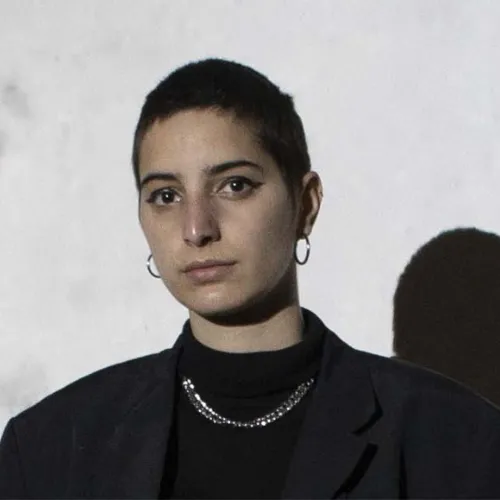
Dina Mimi is a Palestinian visual artist and filmmaker who is based between Palestine and the Netherlands. Mimi works with experimental filmmaking and lecture performances that research the question of how and when bodies become sites of resistance. This question finds its material interest in moving images, especially found footage, that is discarded and therefore deemed worthless. Seeing editing as a playground, Mimi plays with opacity in moving images by seeking to brush up against footage which tries to be ungraspable or is in the act of vanishing. This is an ongoing attempt at non-linear narration as a means of disfiguring one’s imagination of bodies as sites of resistance.
In Thousand Thrashing Arms, Mimi experiments with the relationship between liberation, dreams and movement by weaving together found footage and her own filmed footage. Drawing on the words of Frantz Fanon—“The first thing which the native learns is to stay in his place and not to go beyond certain limits… I dream I am jumping, swimming, running, climbing”—the film invokes a fractured dream, by layering pixelated imagery onto high-resolution footage, in order to stretch the viewer’s imagination of liberatory insurgencies.
The film juxtaposes scenes of human and non-human figures in movement, from statues and animals to bodies wrapped in cloth, depicted in states of captivity, traversing tunnels, or resisting from underground. The edges of the body and its capacity for resisting are traversed, the body that can become concrete and steel can house foreign chants of the underground. Mimi suggests that the film itself is labouring and conspiring to represent a (dissociative) dream, patching together poetic gestures of running in reverse, skipping feet, and wrapping arms, all for the inevitable sake of freedom.
Special prize
Commenting on Dina Mimi as the winner of the special prize, the Jury said:
“Dina Mimi’s work is impactful through her indirect comment on the political tensions in Palestine today. Through a simple yet inviting display, her video addresses themes of apartheid transnationally and trans-historically. Her approach not only poetically translates historical trauma but also examines the body as a site of opacity and disappearance. Mimi’s work fuses the personal and the political, strongly articulating word and image (using South African IsiXhosa as chosen language) to open up a path for cultural translation in the realm of the moving image.”
