
Ipeh Nur
Taking inspiration from Indonesian history, as well as her personal memories and experience, Ipeh Nur creates works that touch upon the topics of mythologies and legends and how they affect the life of the local communities.
A construction of an unusual form is standing in the space – barely lit, it entices the audience to come near and explore the drawings covering its surface. Up close, they remind a surreal vision in between dream and delusion, where different images intertwine and flow into one another, leaving the viewer in a state between the curiosity of further contemplation and disturbance. The quiet voice of the narrator hints at the possibility of going inside, where, apart from the film, new images might be found in darkness.
Interested in the nature of myths and their passage from generation to generation, Ipeh Nur attempts to reconsider long-standing beliefs and how they metaphorize today’s events. In her work The Waves Haven’t Slept she refers to the legend about the Nyai Roro Kidul, which means the Queen of the South Sea in Indonesian. Known as a sacred queen and spirit in Javanese mythology, she was deeply connected to the cultural and spiritual life of Yogyakarta and the Mataram Kingdom. Due to the Javanese Chronicle, she was associated with protection and power, as well as spirituality and mystery. It was also claimed that she had connections to natural disasters, such as tsunamis. Bringing together history, geomythology, and the natural world, the legends reflect Nyai Roro Kidul as guardian deity, representing hope and control over the forces of nature.
Diving into her childhood memories of her grandfather and the South Sea, Ipeh Nur takes an intuitive journey that immerses into memories, myths, and history. She creates an imaginary space – like a cave or a fortress – which reminds of protection, faith, and hope.
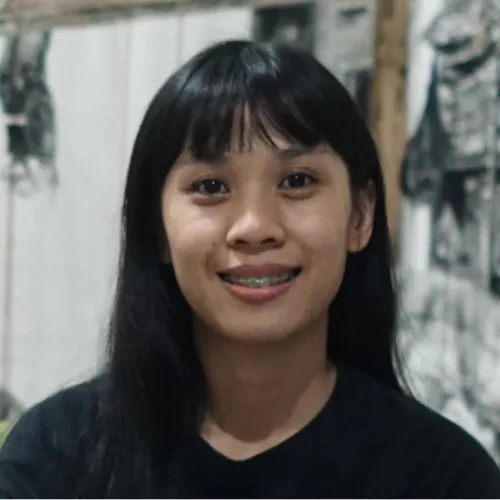
Taking inspiration from Indonesian history, as well as her personal memories and experience, Ipeh Nur creates works that touch upon the topics of mythologies and legends and how they affect the life of the local communities.
A construction of an unusual form is standing in the space – barely lit, it entices the audience to come near and explore the drawings covering its surface. Up close, they remind a surreal vision in between dream and delusion, where different images intertwine and flow into one another, leaving the viewer in a state between the curiosity of further contemplation and disturbance. The quiet voice of the narrator hints at the possibility of going inside, where, apart from the film, new images might be found in darkness.
Interested in the nature of myths and their passage from generation to generation, Ipeh Nur attempts to reconsider long-standing beliefs and how they metaphorize today’s events. In her work The Waves Haven’t Slept she refers to the legend about the Nyai Roro Kidul, which means the Queen of the South Sea in Indonesian. Known as a sacred queen and spirit in Javanese mythology, she was deeply connected to the cultural and spiritual life of Yogyakarta and the Mataram Kingdom. Due to the Javanese Chronicle, she was associated with protection and power, as well as spirituality and mystery. It was also claimed that she had connections to natural disasters, such as tsunamis. Bringing together history, geomythology, and the natural world, the legends reflect Nyai Roro Kidul as guardian deity, representing hope and control over the forces of nature.
Diving into her childhood memories of her grandfather and the South Sea, Ipeh Nur takes an intuitive journey that immerses into memories, myths, and history. She creates an imaginary space – like a cave or a fortress – which reminds of protection, faith, and hope.
Spesial prize
Commenting on Ipeh Nur as the winner of the special prize, the Jury said:
“Using metaphor, Ipeh reconstructs the inner space that we carry within us; made of memories, myths, experiences and reflections about what surrounds us. Her immersive installation provides a safe space for a personal geneaology of stories and myths embedded in her local environment. Drawing the visitor into a dreamlike environment, Ipeh invites us into a whole world within her work.”
