
Lap-See Lam
Lap-See Lam, born 1990, based in Stockholm (SE). Lap-See Lam draws attention to the cultural history of increasingly-scarce Chinese restaurants in Sweden which are intimately intertwined with the imprints of the Hong Kong-Chinese diaspora across the world. Using fiction as a tool and the particular interior aesthetics of the restaurants as a formal language, Lam considers how the concept of a place constructs notions of cultural identity and belonging. Lam utilises technologies including VR, 3D-scanning and 3D-printing to create complex, immersive and poetic environments in her work. Recent exhibitions include: Galerie Nordenhake, Stockholm (2020), Uppsala Art Museum (2020), Performa 19 Biennial, NY (2019); Fondation Cartier, Paris (2019); Moderna Museet, Malmö (2019-2018) and Luleå Biennial (2018). Lam is a recipient of the Maria Bonnier Dahlin Foundation Grant in 2017.
Lap-See Lam, born 1990, based in Stockholm (SE). Lap-See Lam draws attention to the cultural history of increasingly-scarce Chinese restaurants in Sweden which are intimately intertwined with the imprints of the Hong Kong-Chinese diaspora across the world. Using fiction as a tool and the particular interior aesthetics of the restaurants as a formal language, Lam considers how the concept of a place constructs notions of cultural identity and belonging. Lam utilises technologies including VR, 3D-scanning and 3D-printing to create complex, immersive and poetic environments in her work. Recent exhibitions include: Galerie Nordenhake, Stockholm (2020), Uppsala Art Museum (2020), Performa 19 Biennial, NY (2019); Fondation Cartier, Paris (2019); Moderna Museet, Malmö (2019-2018) and Luleå Biennial (2018). Lam is a recipient of the Maria Bonnier Dahlin Foundation Grant in 2017.
Lap-See Lam employs VR technology, 3D scanning and animation to explore the history of the Cantonese diaspora in Sweden. Her main subjects are Chinese restaurants in Stockholm, their interior aesthetics and cultural codes. Via these establishments Lam considers the role that such specific sites have on the construction of the identity, as well as the history and heritage of a particular local community. She intertwines fictional narratives in complex immersive installations, combining sculpture ensembles with poetic stories in virtual reality.
In her expanded narrative, Lap-See Lam presents her ongoing project Phantom Banquet, based on the story of a young waitress who disappears through a mirror and into another dimension in 1978 in Stockholm. The installation is divided into several chapters. The viewer’s journey begins in the remnants of a dining room of a now-defunct restaurant.The tables and chairs have become digital ruins, reduced to a blurry illusion.
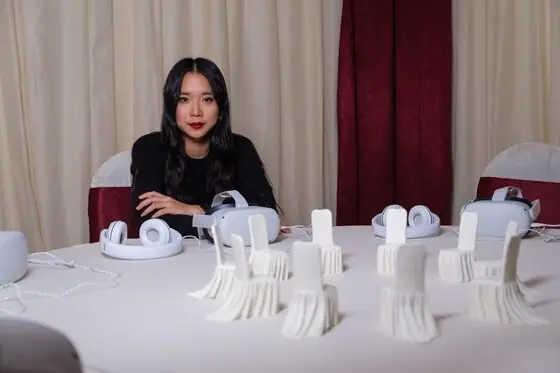
The following space is illuminated by the neon sculpture of a ghost — a form generated by the moving figures accidentally captured by Lam’s 3D scanner in the restaurant. Its figure appears as an ancestor and a guide to the banquet room around the corner. The closed and intimate space with a round table in the centre brings to mind a spiritualistic seance. Through VR headsets the visitors are transported into another dimension, where, together with a mysterious guide, they cross over the dark universe of restaurants that once existed, a space that expands over the course of the trip.
The paper sculptures presented in the space are part of an upcoming project that continues where the story of Phantom Banquet ends. They belong to the character Singing Chef, and each paper suit is named after the place from which its shadow motifs are collected.
By making possible a space of shared collective memory and experience, Lap-See Lam creates a sensitive anthropological study on the notions of heritage, metaphysics, technologies, and otherness.
