
Marie-Сlaire Messouma Manlanbien
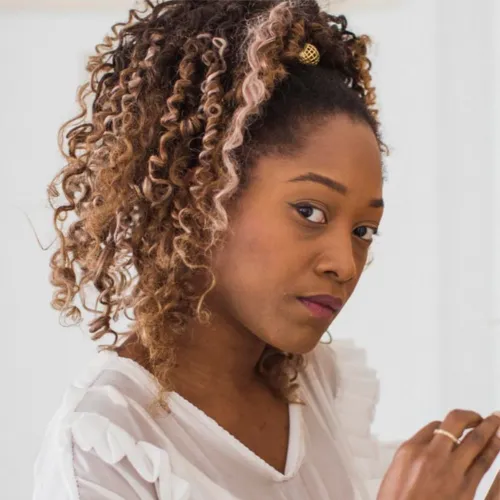
Drawing from diverse knowledge systems, mythologies, and craftmaking traditions, Marie-Claire Messouma Manlanbien creates powerfully evocative installations. She explores themes of femininity and healing, often incorporating ancient symbols and medicinal plants, while shedding light on historically marginalized or forbidden practices.
In her new tapestry and immersive installation, the artist weaves together various scenes that bear witness to the rescue of the wounded, bodies pulled from rubble, soldiers heading into battle, and populations fleeing wars and famines. These moments reflect the shared search for a better future across different parts of the world—from Africa to Asia, passing through America and Europe. Woven with a blood-red thread, different wars and conflicts—Israel-Palestine, Russia-Ukraine, Libya, armed struggles in Burkina Faso, Somalia, Sudan, Yemen, Myanmar, Nigeria, Syria, Azerbaijan-Armenia, the two Koreas, and more—are intertwined, and overlapping. The artist conveys that we are all touched by the pain and turmoil that forces people to flee by road, air, or sea, with many perishing in the waters. Those seeking a better future are often turned away upon arrival in Europe or America, while those with the right documents and passports are welcomed everywhere.
Scattered throughout the tapestry are remedies and medicines crafted by the artist in order to heal, to soothe. These are surrounded by trays displaying tools and treatments inspired by indigenous healing methods from various African regions, alongside modern techniques reimagined by the artist. The trays hold syringes filled with plant powders and seeds, needles and thread ready for use, compresses soaked in clove solutions, bowls of water—the essence of life—and mounds of soil.
The thick red rope running through the installation and connecting different objects symbolizes an umbilical cord that connects us all, highlighting our shared present. The scene rests on survival blankets, emphasizing themes of life, fragility, and interconnection.
Drawing from diverse knowledge systems, mythologies, and craftmaking traditions, Marie-Claire Messouma Manlanbien creates powerfully evocative installations. She explores themes of femininity and healing, often incorporating ancient symbols and medicinal plants, while shedding light on historically marginalized or forbidden practices.
In her new tapestry and immersive installation, the artist weaves together various scenes that bear witness to the rescue of the wounded, bodies pulled from rubble, soldiers heading into battle, and populations fleeing wars and famines. These moments reflect the shared search for a better future across different parts of the world—from Africa to Asia, passing through America and Europe. Woven with a blood-red thread, different wars and conflicts—Israel-Palestine, Russia-Ukraine, Libya, armed struggles in Burkina Faso, Somalia, Sudan, Yemen, Myanmar, Nigeria, Syria, Azerbaijan-Armenia, the two Koreas, and more—are intertwined, and overlapping. The artist conveys that we are all touched by the pain and turmoil that forces people to flee by road, air, or sea, with many perishing in the waters. Those seeking a better future are often turned away upon arrival in Europe or America, while those with the right documents and passports are welcomed everywhere.
Scattered throughout the tapestry are remedies and medicines crafted by the artist in order to heal, to soothe. These are surrounded by trays displaying tools and treatments inspired by indigenous healing methods from various African regions, alongside modern techniques reimagined by the artist. The trays hold syringes filled with plant powders and seeds, needles and thread ready for use, compresses soaked in clove solutions, bowls of water—the essence of life—and mounds of soil.
The thick red rope running through the installation and connecting different objects symbolizes an umbilical cord that connects us all, highlighting our shared present. The scene rests on survival blankets, emphasizing themes of life, fragility, and interconnection.
