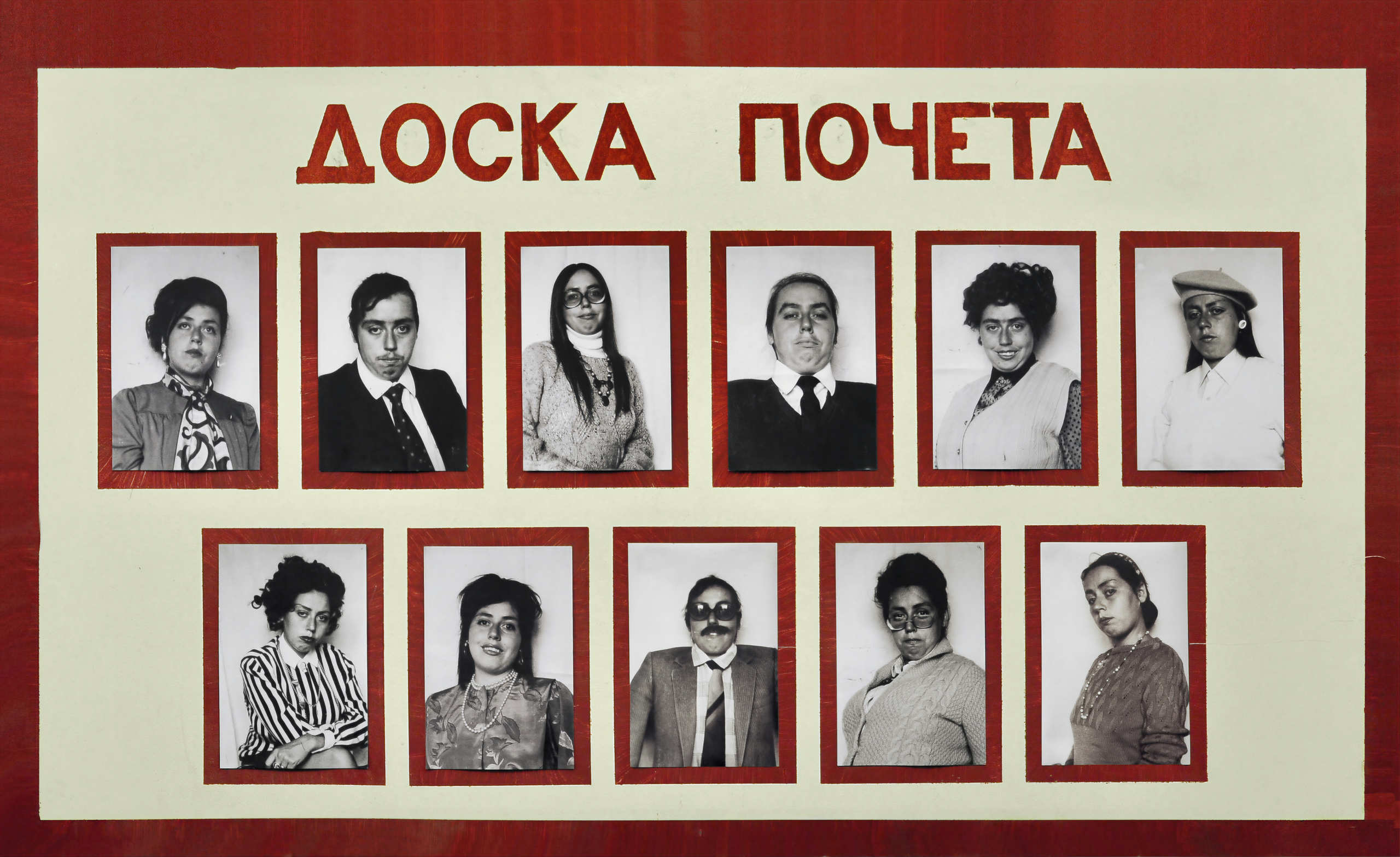
Zhanna Kadyrova. Honour Board series. 2003. Вlack-and-white photograph, 19 × 28 cm. Аcrylic on particleboard, 180 × 130 cm
Series description
This photographic series became one of Zhanna Kadyrova’s first public works after graduating in 1999 from the Taras Shevchenko State Art Secondary School (now the Kyiv State Art Lyceum named after T. H. Shevchenko). To create the photographs, the artist selected a number of traditional images of Soviet workers, including a school teacher, librarian, secretary, and others, and then, having prepared the costumes, transformed into them. The artist presented the photographs in a collage format on a chipboard panel, recreating the honor board — a mandatory attribute of the workspace during the USSR era, which was placed in factories, schools, universities, and ministries, in short — anywhere. Such boards displayed the achievements of the best workers who exceeded the plans set by management. In this way, managers formed inflated expectations of workers and spread the exploitative logic of management. Although more than ten years have passed since the collapse of the Soviet Union, Kadyrova’s board has not lost its relevance. This logic carried over into the times of independence, which is only embraced and welcomed by the neoliberal politics of the present. The work also refers to the photographic series of American artist Cindy Sherman, who criticized identities imposed by society and media through transformations into archetypal images of visual culture.
Kadyrova’s series captures her initial search for a form of expression. Later, the artist rarely returned to photography, as she preferred working in the mediums of sculpture and installation. It is also worth noting the presence of the artist herself in her own work: usually her figure is neither part of the concept of her works nor their visual sequence.
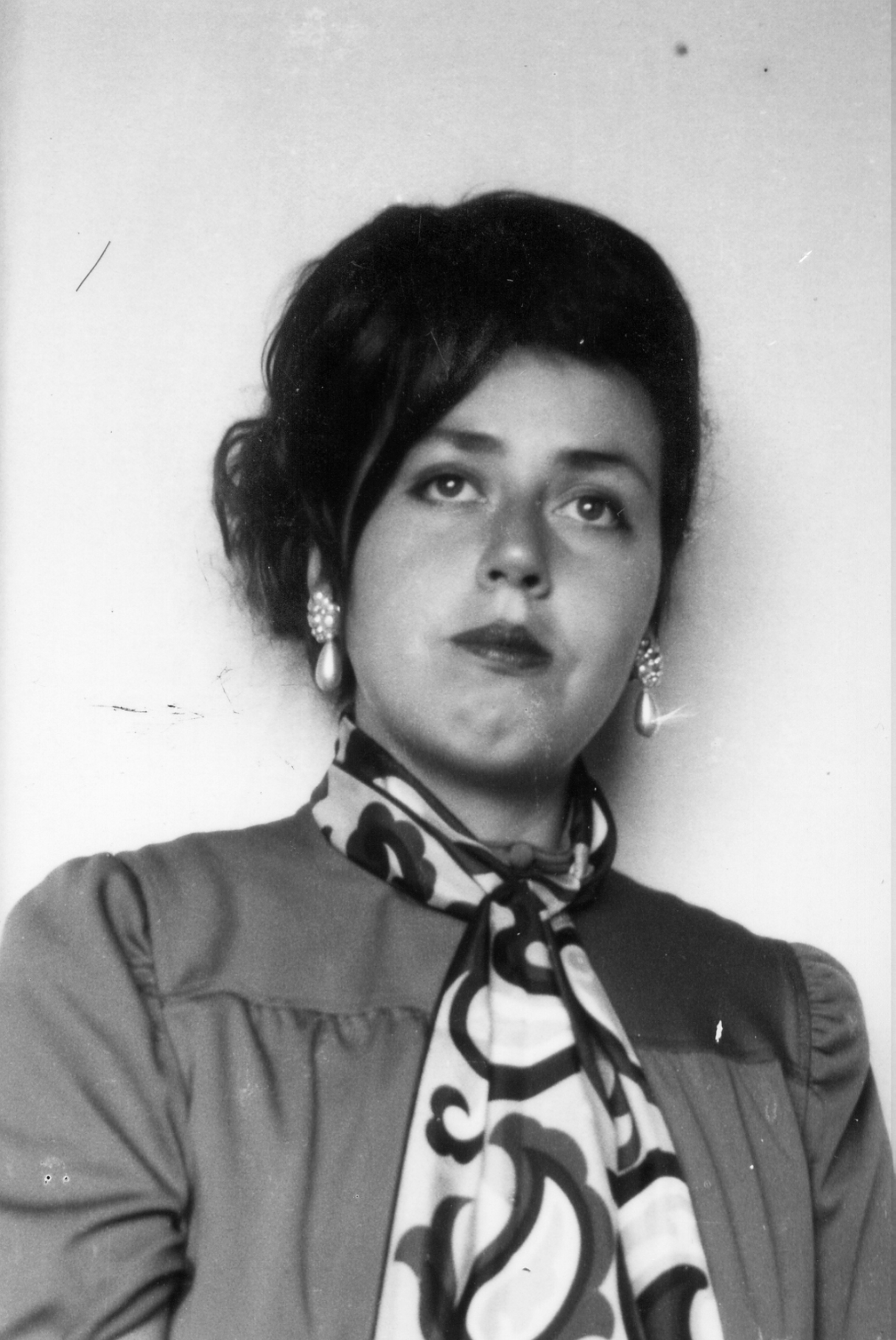
Despite the superficial self-portrait nature of the photographs, there is no “real” Kadyrova on the “Honor Board”; instead, there is an embodiment of female and male types based on gender performativity — a concept proposed by Judith Butler, explaining gender as a role that people choose and play throughout their lives. Thus, the “Honor Board” transcends the framework of a parodic-nostalgic appeal to the Soviet past and becomes a commentary on gender as a constructed reality. Kadyrova’s convincing transformations remind us that the concepts of “male” and “female” can safely be put in quotation marks, as they are often just a set of certain external attributes. In this gender conditionality, which brings Kadyrova’s work closer to Cindy Sherman’s photographic performances and bridges to other artists working with gender criticism, there is a certain level of freedom embedded, since the role is not an innate essence — it can be partially or completely modified [1].
- Chervynik O., “Honor Board.”, in Zhanna Kadyrova., (Kyiv: Publishing Program of the Volodymyr Smirnov and Kostyantyn Sorokin Foundation, 2013), p. 24.